

TrustSafe Enigmator Discovery
A PQC discovery platform to identify classical cryptographic exposure
To Know More


TrustSafe Enigmator Discovery (TSED) is a purpose-built post-quantum cryptography (PQC) discovery platform designed to provide organizations with the visibility required to secure their digital infrastructure against future quantum threats. It serves as a foundational tool for identifying classical cryptographic exposure and establishing a structured migration path to quantum-resistant algorithms.
-
Automated Enterprise Scanning: Automatically scans file systems, repositories, and network equipment to locate cryptographic keys, certificates, and trust materials.
-
Deep Attribute Analysis: Extracts and analyzes critical metadata, including algorithm types, key lengths, usage, expiry dates, and trust chains.
-
Quantum-Safe Readiness: Specifically focuses on identifying assets at risk from future quantum computers that could break current cryptographic standards.
-
Centralized Visibility: Consolidates discovered data into a central platform to help organizations evaluate their PQC maturity and transition journey.
.png)
The Critical Need for TSED:
Protecting Digital Assets
In the modern enterprise, the integrity of the most valuable digital assets — ranging from legal documents and digital identities to sensitive corporate data and cryptocurrencies — rests entirely on a sophisticated system of "digital locks and keys" known as Public Key Infrastructure (PKI). This framework proves ownership and maintains privacy through the use of X.509 certificates, cryptographic keys, and keystores, which serve as the invisible backbone of secure corporate communication.
The Inherent Risks in Classical PKI
The cryptographic standards currently protecting your organization were designed to withstand classical computing threats, but they possess a fundamental vulnerability: they rely on mathematical problems that future quantum computers will be able to break. This creates an immediate risk through "Harvest Now, Decrypt Later" attacks, where adversaries capture and store your encrypted sensitive data today, intending to decrypt it the moment quantum technology matures. Furthermore, many of these "digital keys" are invisible to traditional security scans, as they often exist only within running services like load balancers, Kubernetes ingress, and Hardware Security Module (HSM) rather then as static files on a server.
The Strategic Urgency of the PQC Upgrade
The transition to Post-Quantum Cryptography (PQC) is a mission-critical mandate that must begin now. NIST has already released the principal PQC standards — FIPS 203, 204, and 205 — and explicitly advises organizations to put them into use immediately to secure electronic information against quantum threats. Because a full cryptographic migration is a highly complex undertaking that typically takes several years, waiting for the arrival of a quantum computer to begin the transition is not a viable strategy. Regulatory pressure is also mounting, with NIST moving to deprecate and remove quantum-vulnerable algorithms from its standards by 2035, with high-risk systems expected to transition much earlier.
The Critical Need for TrustSafe Enigmator Discovery (TSED)
You cannot protect what you cannot see. The foundational step of any quantum-safe journey us visibility. TrustSafe Enigmator Discovery (TSED) is a purpose-built platform designed to bridge the gap between legacy PKI and a quantum-resistant future. By providing an automated, enterprise-wide scan of your cryptographic landscape, TSED enables you to:
-
Establish a Full Inventory: Maintain a complete catalog of all cryptographic use cases, which is a key requirement for reaching advanced levels of PQC maturity.
-
Identity Hidden Exposure: Locate certificates and keys within repositories, network equipment, and running cloud services that standard tools overlook.
-
Assess Quantum Readiness: Automatically flag non-quantum-safe features and algorithms for formal risk mitigation.
-
Build a Migration Roadmap: Transform technical metadata into a structured path for upgrading your organization's digital locks and keys to NIST-approved PQC standards.
Core Functions
TSED provides a comprehensive suite of functions to manage the entire cryptographic lifecycle during the PQC transition.

Data Collection and Discovery
-
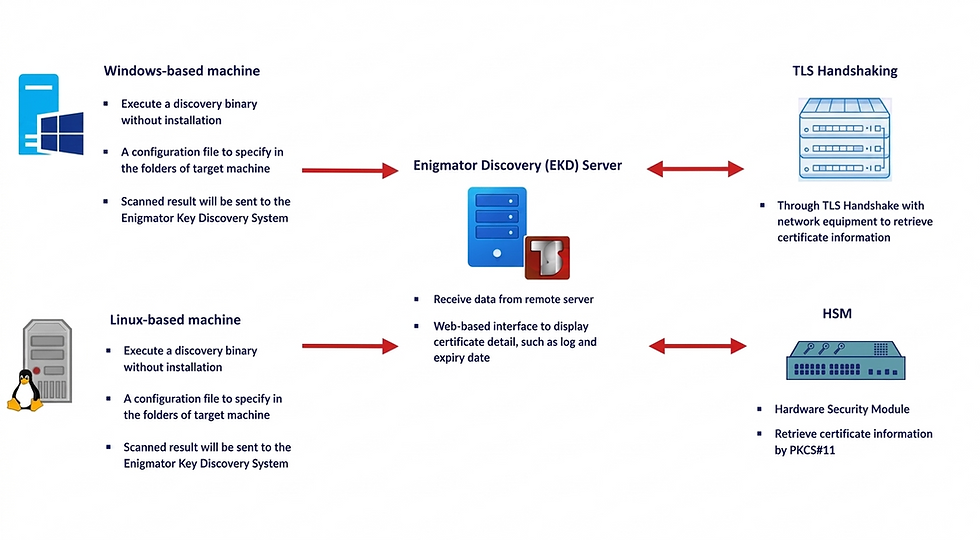
Performs agent-based scanning on target servers to find keys and certificates with file systems.
-
Includes a TLS harvester that scans network services (such as HTTPS, SMTPS, and LDAPS) to collect certificates presented during handshakes.
-
Supports offline operation, allowing discovery data to be stored locally on a host and imported to the central server later.

Analysis and Inventory
-
Maintains a full inventory of all cryptographic use cases and assets.
-
Provides a PQC Readiness Assessment, flagging non-quantum-safe features for risk mitigation.
-
Extracts detailed object metadata, such as file hash, key size, and signature algorithms (e.g. RSA-SHA256).

Security, Monitoring, and Reporting
-
Features Role-Based Access Control (RABC) and detailed audit logging to ensure only authorized personnel can view sensitive discovery data.
-
Generates expiration alerts and failure notifications to prevent service outages caused by expired certificates.
-
Provides board-ready executive summaries and migration roadmaps to guide stakeholders through the quantum-readiness journey.
Key Advantages
The TSED architecture is designed for rapid deployment and high security, ensuring that organizations can gain visibility into their cryptographic landscape with minimal operational friction.
1. No-installation Scanning Agent. Lightweight Discovery with Negligible Performance Impact
-
Preserving Business Continuity and Operational SLAs. TSED's agent is engineered to be lightweight, executing as a standalone binary that identities cryptographic assets with negligible overhead on the host system's performance. This ensures that your mission-critical applications and revenue-generating services continue to meet their operational performance requirements and Service Level Agreement (SLAs) even during comprehensive discovery cycles.
-
Accelerated Time-to-Visibility with Zero Deployment Friction. Traditional security software often required lengthy installation procedures, complex change management approvals, and system reboots, which can delay strategic PQC migration planning for months. TSED eliminates this "deployment debt" by using a no-installation engine that allows the cybersecurity teams to move rapidly from "Initial" to "Advanced" maturity levels — establishing a full inventory of use cases without the bureaucratic and technical delays of traditional agent rollouts.
-
Efficient Resource Management and Metadata-Centric Transmission. TSED optimizes organizational bandwidth and storage by focusing solely on extracting deep cryptographic metadata — such as algorithm types, key lengths, and expiry dates — rather than processing entire data sets. This metadata-centric approach minimized network traffic and allows the central Enigmator Discovery Server to build a comprehensive Cryptographic Bill of Materials (CBOM) without straining enterprise infrastructure. By transmitting only the essential "blueprints" of your digital locks and keys, TSED enables leadership to focus resources on roadmap development and risk mitigation rather than troubleshooting infrastructure performance.
2. The Enigmator Discovery Server:
A Hardened Virtual Foundation for Strategic Cryptographic Governance
-
Operational Efficiency through an All-in-One Integrated Design. The Enigmator Discovery Server is delivered as a pre-configured, self-contained virtual appliance that integrates a hardened operating system, a high-performance web server, and a secure internal database. This translates to a significantly lower Total Cost of Ownership (TCO) and a faster "time-to-visibility", as it eliminates the need to procure, license, or maintain separate external database infrastructure.
-
Strategic Risk Oversight via Centralized Management. The platform provides a unified, web-based interface that consolidates discovery results, system logs, and certificate expiry details from every corner of the enterprise — including repositories, network equipment, and Hardware Security Module (HSM). This centralized visibility is essential for reaching Advanced and Managed PQC Maturity Levels (Level 3 and 4), which mandate maintaining a full inventory and a detailed Cryptographic Bill of Materials (CBOM). This function transforms raw technical data into actionable business intelligence, enabling the setting of asset criticality and the development of a structured migration roadmap based on actual cryptographic exposure across the entire organization.
-
Data Sovereignty and Enhanced Security within a Hardened Environment. The Enigmator Discovery Server functions as a hardened virtual appliance, ensuring complete data sovereignty by securing your organization's "cryptographic blueprint" within your local perimeter. By housing sensitive metadata — including algorithm types and key lengths — internally, TSED eliminates third-party cloud risks and establishes the Cryptographic Bill of Materials (CBOM) necessary for advanced PQC maturity. Furthermore, integrated RBAC and detailed audit logging restrict visibility to authorized personnel, upholding the highest standards of corporate governance and security compliance.
3. Strategic Importance of Local Data Sovereignty:
Flexible Handling for Stringent and Isolated Security Architectures
-
By deploying the TrustSafe Enigmator Discovery (TSED) Virtual Appliance locally, organizations mitigate significant supply chain risks by ensuring their sensitive "cryptographic blueprint" remains within a hardened internal perimeter rather than becoming a massive target on a third-party cloud. This local infrastructure provides total internal control over sensitive metadata, enabling the maintenance of a Cryptographic Bill of Materials (CBOM) that details deep attributes such as algorithm types, key lengths, and usage contexts. Establishing such a CBOM is a critical requirement for achieving "Level 4: Managed" maturity in the Post-Quantum Cryptography Maturity Model, as it provides the essential visibility needed to disable legacy algorithms and enforce quantum-safe defaults throughout the organization.
-
TSED's scanning engine enables secure discovery in isolated segments through offline operation, identifying keys and certificates and storing metadata locally without any network connection. These results can be manually imported into the central Enigmator Discovery Server for consolidation, allowing organizations to maintain the full inventory of all cryptographic use cases required for advanced PQC maturity while ensuring that sensitive air-gapped zones remain physically and logically protected.
-
Compliance Without Connectivity: NIST and other regulatory bodies mandate that "high-risk systems" transition to PQC earlier than general-purpose systems. TSED's offline capability ensures these high-risk, isolated systems are not left as "blind spots" in your quantum-readiness roadmap.


